Bosnia is still finding bodies from a genocide some leaders claim never happened 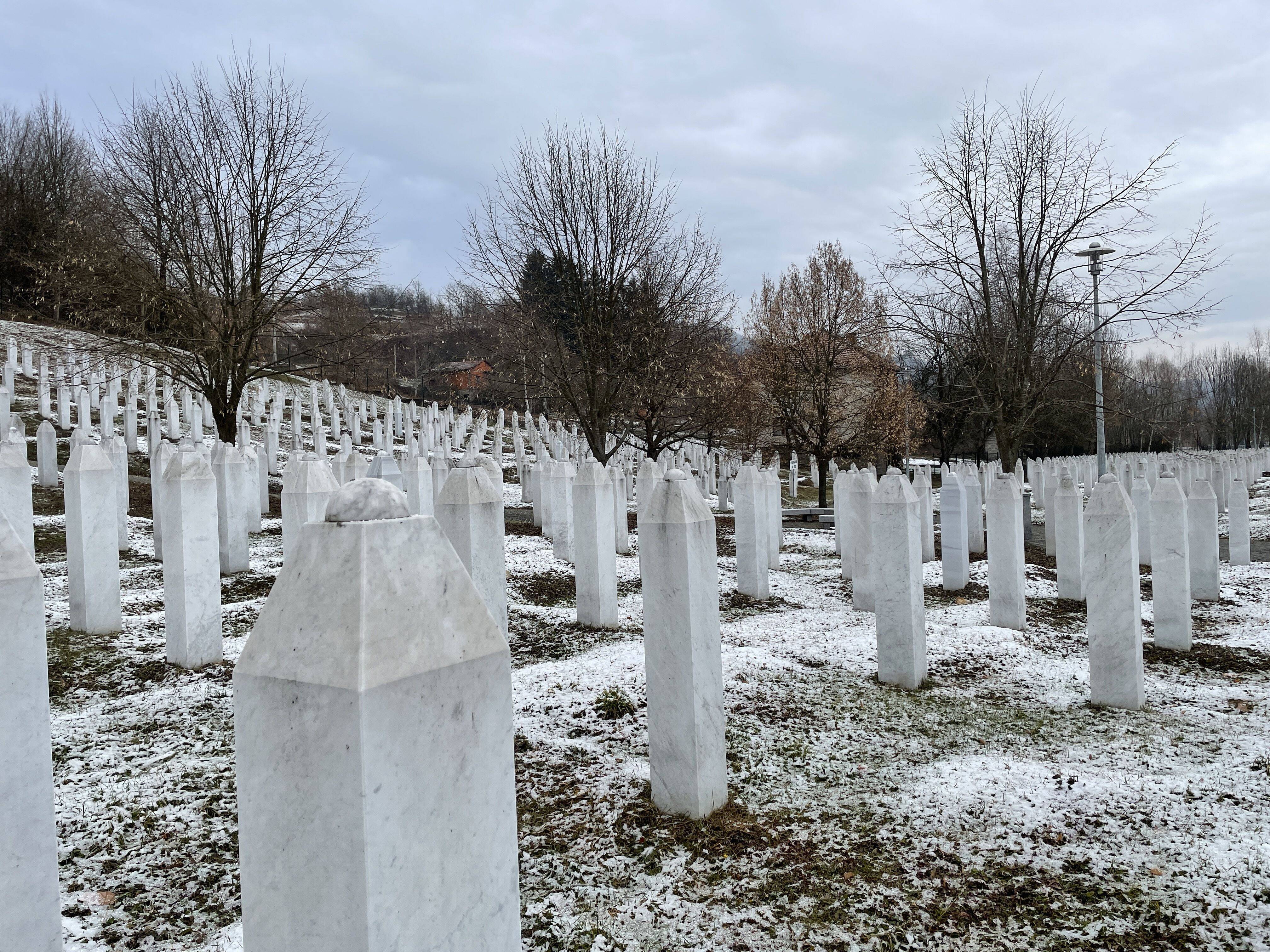 A cemetery in Srebrenica for genocide victims in Bosnia and Herzegovina, on Feb. 8, 2022. (Chico Harlan/The Washington Post) | SREBRENICA, Bosnia — The gravestones stretch for nearly a quarter mile — 7,000 Bosnian Muslim men and boys, slaughtered in a matter of days — but the region's top politician says the coffins are empty. The local mayor has said some of the purported victims are still alive. The commander who led the massacre is portrayed as a hero on posters that periodically appear near the cemetery. It's been 26 years since the killings in Srebrenica, a genocide that broke Europe's never-again vow and constituted the bloodiest period of this nation's three-year war. Much of the world turned its attention away from the Balkans after the U.S.-brokered peace deal in 1995, and the subsequent trial at The Hague, which handed down war crime convictions and life sentences. But a battle over reality is now pushing the country to a breaking point. This is a place where genocide survivors live right next to people who say it never happened — or that it wasn't so bad. Denialism has long been an undercurrent of Bosnian politics and life. But in recent years, it has intensified, amplified by social media and by Bosnian Serb nationalist leader Milorad Dodik, who has called the massacre a "myth" and a "deception." In July, a United Nations envoy intervened. Using extraordinary powers granted in the aftermath of the peace deal, he made genocide denial illegal in Bosnia. That move has spurred a backlash — and fears of a violent dissolution. Bosnia is divided along ethnic and religious lines: the Orthodox Bosnian Serbs, the Catholic Croats and Muslims who are known as Bosniaks. Serbs are the majority in one of the country's territories, called Republika Srpska. Bosniaks and Croats primarily live in the other section, the Federation of Bosnia and Herzegovina. In all parts of the country, unemployment is high. So is corruption. And Bosnia's power-sharing system perpetuates the tensions of the war: Each ethnic group is guaranteed a quota of positions, giving politicians little incentive to be conciliatory. Within days of the genocide denial law, Dodik, the leader of Republika Srpska, halted his fiefdom's participation in state institutions. He warned that his territory would set up its own tax system, its own judiciary, even its own army — essentially resurrecting the forces that carried out the attack in Srebrenica. In November, a successor U.N. envoy assessed that Bosnia was facing "the greatest existential threat of the postwar period." Dodik, who was placed under fresh U.S. sanctions last month, has yet to follow through on the army threat. But two weeks ago lawmakers in his territory voted in favor of establishing a separate judiciary, in defiance of the peace agreement. The potential for new violence remains real. Russia has voiced its support for Dodik's moves. In an interview, Valentin Inzko, the U.N. envoy who drafted the genocide law, said he acted after seeing an "explosion of denialism" that the country's leaders had seemed incapable of stopping. Inzko said he knew there'd be political blowback and described how he'd felt the need to test his convictions before coming to a final decision. So one day before signing the law, he left Sarajevo before sunrise and drove into the countryside. Two hours later, he was alone amid the gravestones of Srebrenica. "You could feel the presence of those men and boys, my God," Inzko said. He returned to Sarajevo by noon, his decision "firm." Dodik called the law the "final nail in the coffin of Bosnia." Because it happened relatively recently, and because international investigators swooped in soon after, Srebrenica is one of the most thoroughly documented genocides in the world. What investigators found was a crime scene that stretched for some 40 miles across eastern Bosnia, with its epicenter in Srebrenica, a mining town that had become a gathering point for some 40,000 Bosnian Muslim refugees during the war. The United Nations had claimed the area was a safe zone, installing peacekeepers to keep the Bosnian Serb army at bay. But the army, commanded by "Butcher of Bosnia" Ratko Mladic, showed up anyway and took control with ease. Serb officers separated the women from the men and boys. "Just don't panic," Mladic told the crowd. In fact, the men and boys were being taken to execution sites. People who tried to escape were gunned down by tanks and machine guns. The bodies were initially buried in mass graves. But weeks later, as it became clear the war might end, they were exhumed and dumped in sites even more remote. The forensic analysts who arrived in the wake of the peace deal tended to find body parts rather than intact corpses, with remains of single individuals scattered across multiple sites. Sometimes bones had been fractured by excavators and bulldozers. Some of the gravesites were hidden away on the farmland of Bosnian Serbs. To this day, remains are occasionally found in the forest. "These are not well-traveled roads," said Matthew Holliday, the head of the International Commission on Missing Persons' Western Balkan program, pointing to a map of gravesites — 95 and counting. "This was an effort to conceal." Given how human remains were jumbled in those graves, the process of identifying the victims has stretched on, too. Some 7,000 people have been buried in Srebrenica's cemetery — their identities confirmed — but experts say the remains of another 1,000 victims have yet to be identified. Some of those remains are missing; others are housed in a prefabricated lab two hours north, where bags of bones and belongings are stacked floor to ceiling. At the lab, forensic anthropologist Dragana Vucetic said her work made the crimes feel like they had just happened. She spread out the partial skeleton of the latest victim identified through DNA work — a 34-year-old whose skull and torso had been found in different mass graves. A separate brown bag sat below the exam table. "Those are the clothes he was wearing," Vucetic said. She unwrapped the bag, and spread its contents across a silver table. Khaki pants, caked in mud. A thick, tattered shirt. "Here's a left shoe," Vucetic said, reaching once more into the bag. Sunlight was coming through the blinds, and the air was thick with dust from the clothing. The next step, Vucetic said, would be for the family to come to the lab, confirm the identification, and consent to the burial — in which case there'd be one more gravestone in Srebrenica. She took an inventory of the bones, the clothing, and then she packed everything away. "Evidence," she called it. Read on: Bosnia is still finding bodies from a genocide some leaders claim never happened | 




 Email
Email 



0 Comments:
Post a Comment