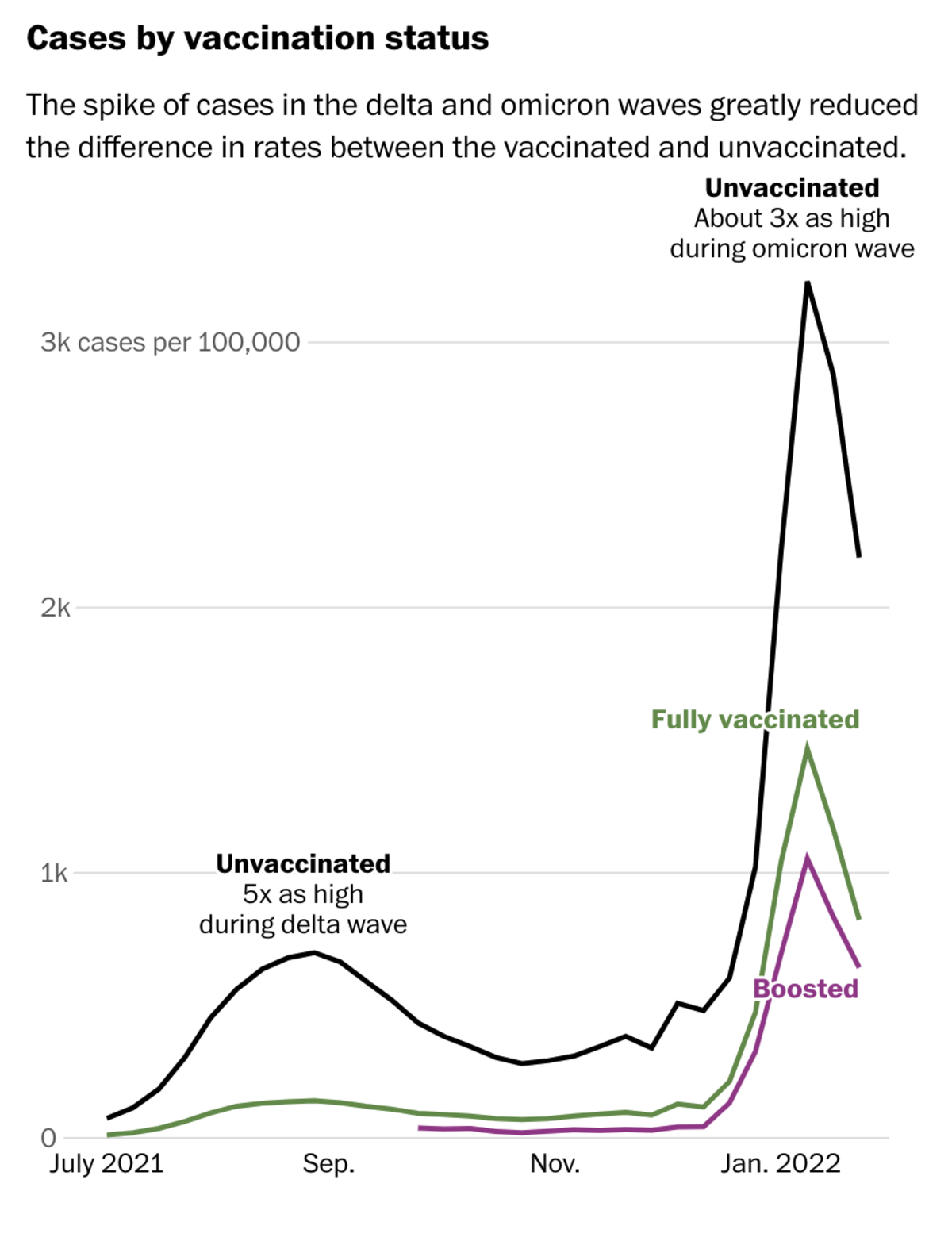
| Welcome to Wednesday's Health 202 — where we're not just tracking health news, but also news of "Hank the Tank," a 500-pound bear who has been breaking into California homes for more than seven months. Meanwhile, in today's edition: A dive into the federal health positions without permanent leaders and when a new study suggests a Moderna booster shot may be needed. But first… | The protection gap between vaccinated and unvaccinated Americans narrowed under omicron | 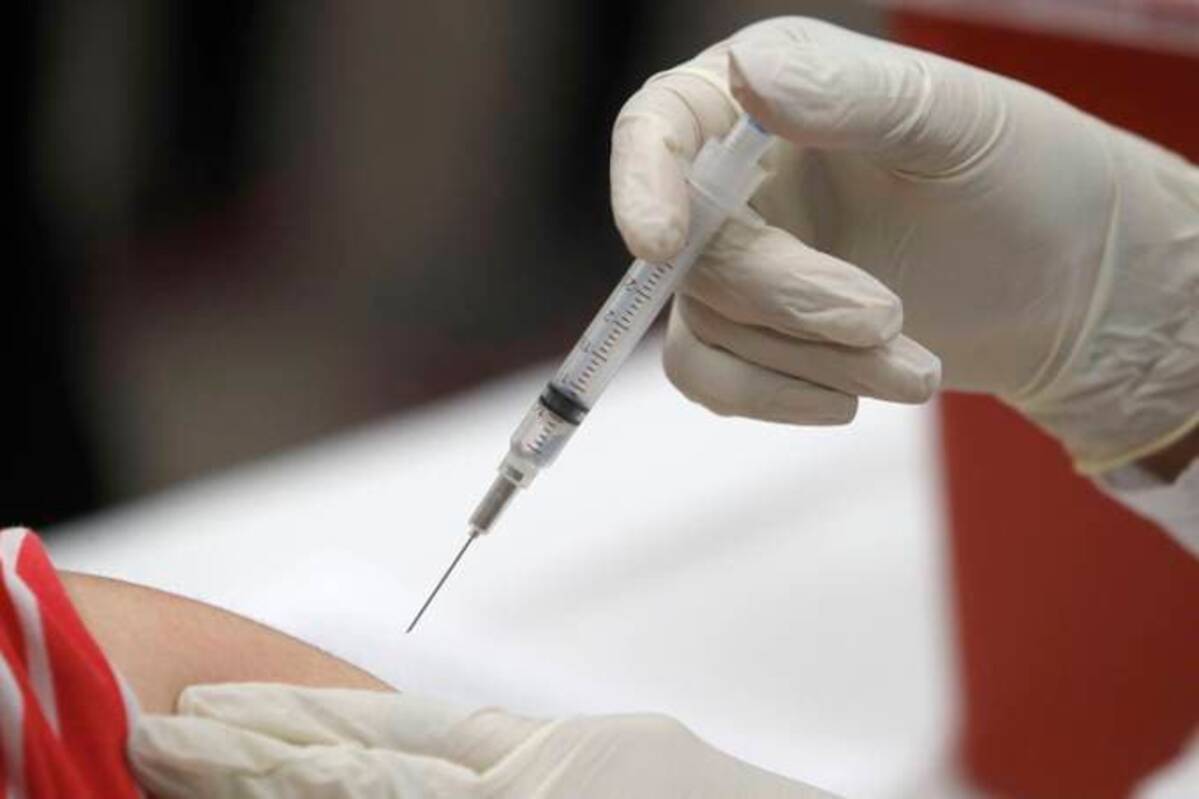 (AP Photo/LM Otero, File) | | | Coronavirus shots provided protection against the omicron variant, but that shield was weaker than during previous waves. What that translated to: Higher rates of infection, hospitalization and death for fully vaccinated adults, as well as those who received their booster shots. Yet, the vaccine still provided ample protection against severe disease and death. That's according to an analysis out this morning from The Post's Dan Keating and Naema Ahmed. The pair dug into new data from the Centers for Disease Control and Prevention and crunched how those who were vaccinated and unvaccinated fared against the virus during its various stages. For instance: Before the delta variant emerged, there were five to 10 cases of the coronavirus for every 100,000 fully vaccinated adults each week. The rate for the unvaccinated was 50 to 90 cases. | - During the delta wave, unvaccinated people were five times as likely to get infected as those who had their shots.
- But during the omicron wave, that difference dropped to less than three times as likely.
| | Driving the change is the vaccines' reduced effectiveness over time, as well as the increasing infectiousness of the variants, Dan and Naema note. Even so, public health experts point to the shots' effectiveness against hospitalization and death as they plead with vaccine holdouts to get immunized. | - "If you look at the data right now — even with omicron — and you look at the protection against severe illness, hospitalizations and deaths is still remarkable," Michael Osterholm, who leads the University of Minnesota's Center for Infectious Disease Research and Policy and advised President Biden's transition team, told The Health 202. "They're not perfect tools, but they are remarkable."
| | The estimates on breakthrough cases come from a sample of health departments tracking the vaccine status of infected people. Let's break down more of the data from our colleagues. Hospitalizations reached record levels amid omicron. The new analysis shows vaccines did provide greater protection against hospitalization than for infection as the contagious variant tore through the country. | - Before the omicron surge, unvaccinated people were 15 times as likely to be hospitalized as those who were fully vaccinated.
- During the omicron surge, that difference in rates dropped to about seven times as much.
| | Those 65 and older have been particularly vulnerable to covid-19 throughout the pandemic. And there was no exception to that trend for hospitalizations amid omicron. | - "I remain most concerned about people who are over the age of 65 who haven't gotten their third dose, and people who are immunocompromised that are eligible for a fourth dose and haven't gotten it," Jennifer Nuzzo, an epidemiologist at the Johns Hopkins Bloomberg School of Public Health, told The Health 202.
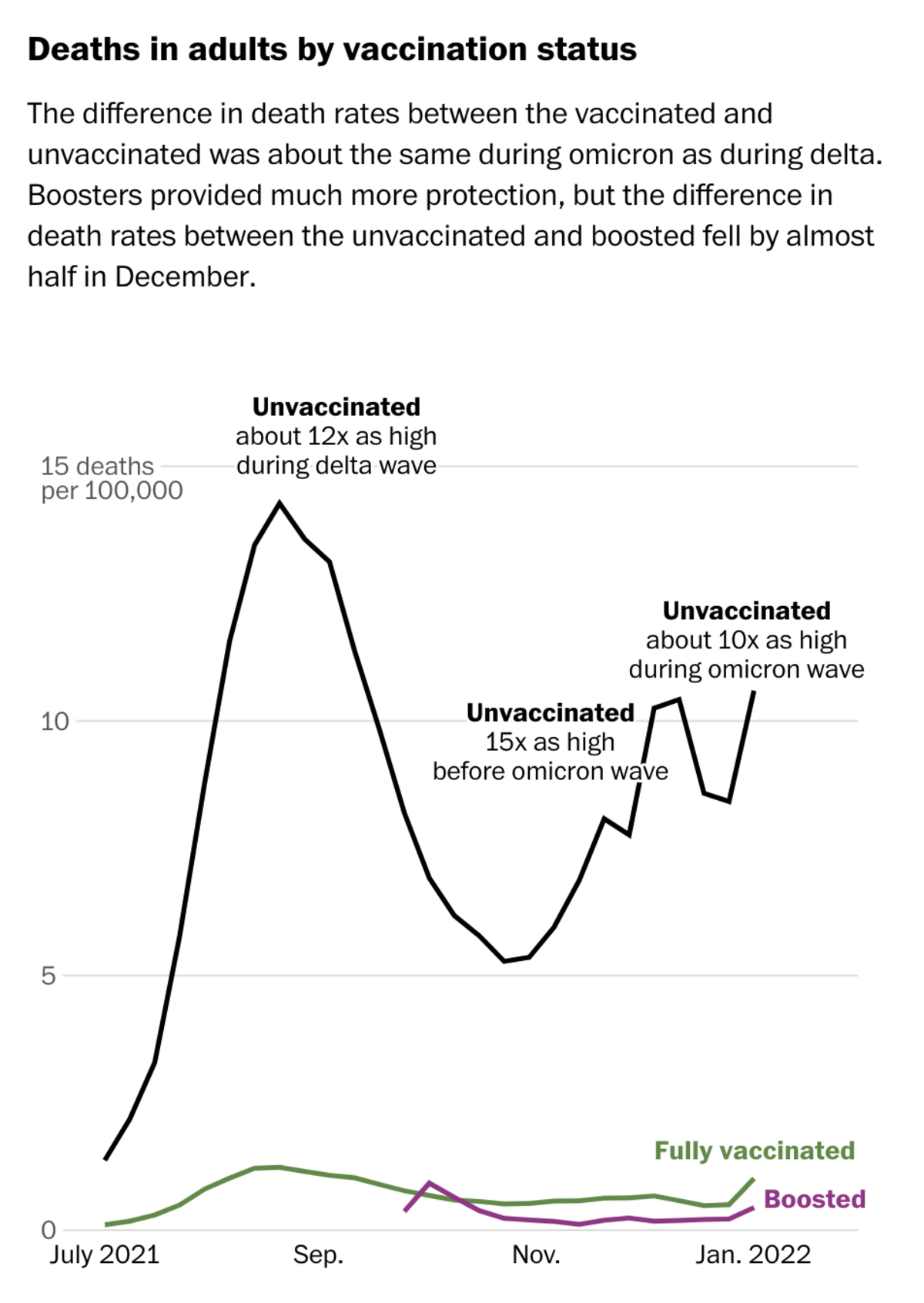
| | The vaccine's greatest protection was against death. The CDC's data on deaths only went through December, our colleagues note, which was before fatalities climbed to their highest point in a year. (Worth noting: Deaths lag behind hospitalizations and cases.) | - Before omicron, unvaccinated Americans were 50 to 60 times as likely to die as those who received the vaccine's primary series and a booster shot.
- At the end of the year, that was reduced to 27 times as high.
| | The data comes as health experts and federal officials continue to weigh how many booster shots Americans should get. | | Booster shots of the Pfizer-BioNTech and Moderna vaccine lose substantial effectiveness after about four months, though they still provide significant protection in keeping people out of the hospital, our colleague Lena H. Sun reported earlier this month. "The potential future requirement for an additional boost or a fourth shot for mRNA or a third shot for J&J is being very carefully monitored in real time," Anthony Fauci, Biden's chief medical adviser, said at covid-19 briefing last week. "And recommendations, if needed, will be updated according to the data as it evolves." | | |  | Agency alert | | Bipartisan support for new health agency falters |  Lawmakers are debating where to house a proposed new agency aimed at propelling health-care research and innovation. (Oliver Contreras/The Washington Post) | | | Bipartisan support for the creation of Biden's proposed Advanced Research Projects Agency for Health (ARPA-H) — which would fund medical research and take on some of the country's biggest health-care challenges — is crumbling, Politico's Sarah Owermohle reports. Living arrangements: The Biden administration has advertised the agency as a new entity within the National Institutes of Health, but some Democrats and Republicans have raised alarms about where the new initiative with a potential budget of $6.5 billion should be housed. | - Fix and reform: Democrats say that before ARPA-H joins NIH, the agency must boost its peer-review process for projects, diversify research grants and ditch ineffective studies more quickly.
- Meanwhile, Politico reports that some GOP lawmakers fear the agency will become a "slush fund for Fauci-minded scientists." Some Republicans say NIH has a "culture problem" that hinders innovation due to slow-moving grants awarded to a small circle of researchers.
| | Either way, a top official from the Office of Science and Technology Policy said Biden has made pushing ARPA-H through Congress a top priority for former NIH director Francis Collins while he is the country's temporary science adviser. Collins is a strong proponent of housing the agency within NIH, leaving Democrats to scramble to heal divisions within their party and win over lawmakers on the other side of the aisle. | | |  | White House prescriptions | | Some key federal positions still don't have permanent leaders | 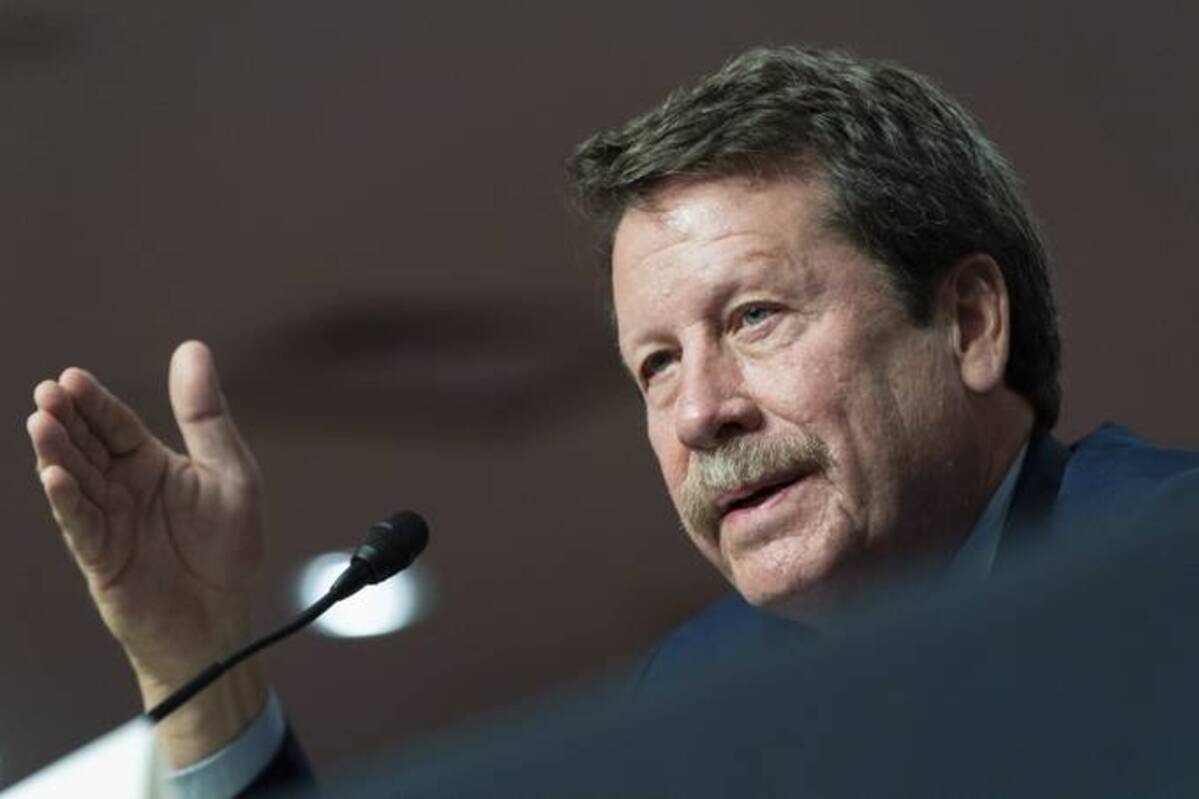 Robert Califf is one of 292 nominees confirmed by the Senate since President Biden took office. (Manuel Balce Ceneta/AP) | | | More than a year after Biden took office, just 41 percent of his nominations for key federal posts have been confirmed by the sharply divided Senate, the Associated Press reports. | | But some positions are open because the administration has yet to pick a nominee, and AP writes that "could put a drag on" on parts of the White House agenda. The administration blames gridlock from Republicans. The average time for Biden's confirmations in the Senate are longer than that of the last three presidents, per a Biden appointee tracker from The Post and the Partnership for Public Service. Within the Department of Health and Human Services: Four candidates are awaiting a green light from the Senate, and another was withdrawn last month. Four positions in need of Senate confirmation remain without a nominee, including an NIH director after Collins stepped down late last year. The Senate confirmed a critical nominee last week: Robert Califf to lead the Food and Drug Administration. Meanwhile, the Office of Science and Technology Policy post is vacant due to Eric Lander's resignation after Politico reported on a White House investigation that found "credible evidence" he bullied and demeaned subordinates. | | |  | Coronavirus | | Moderna booster may be needed sooner than originally thought | 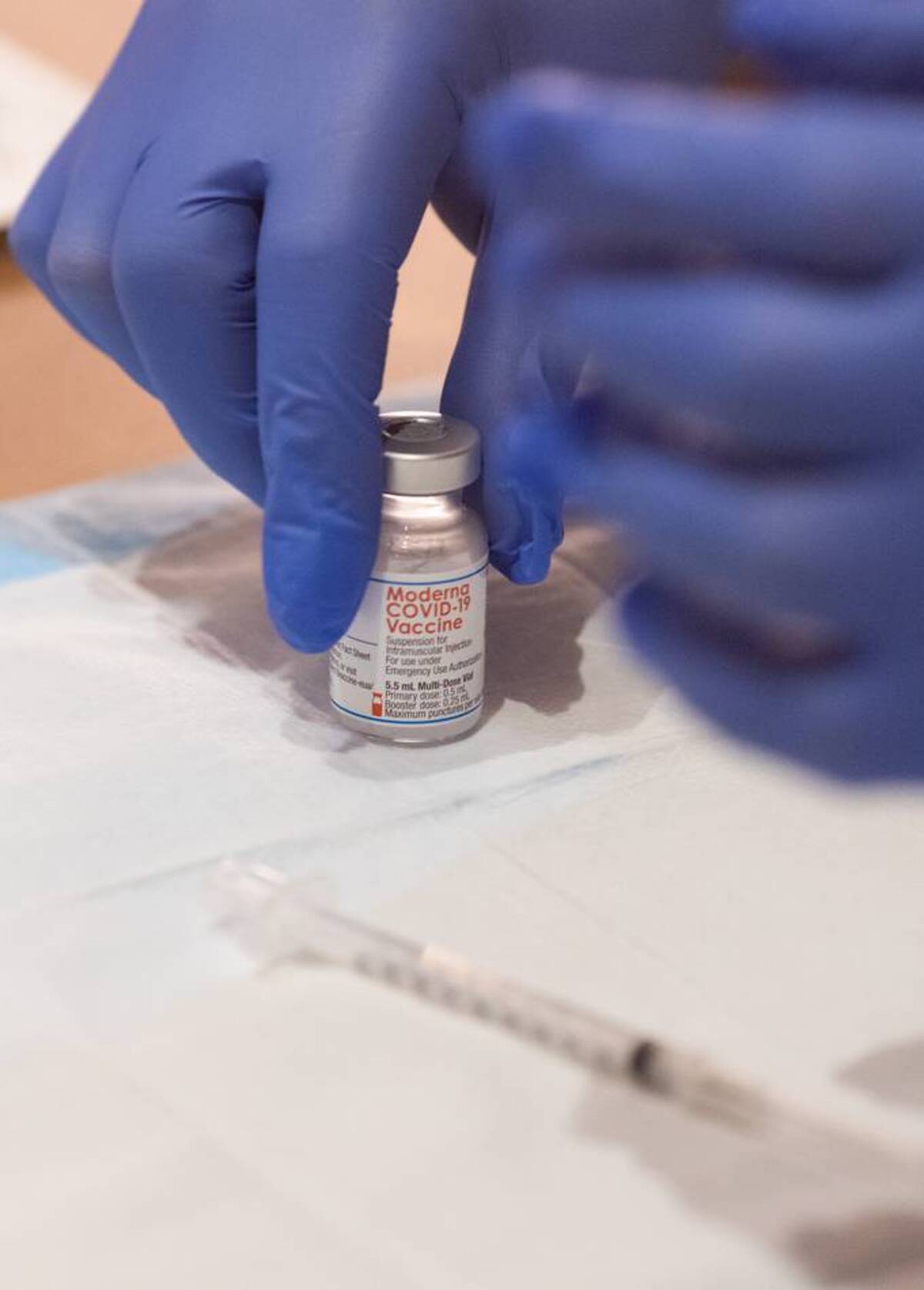 A vial of the Moderna vaccine. (Allison Shelley/The Washington Post) | | | New research suggests a booster shot of the Moderna coronavirus vaccine may be needed sooner than six months, The Post's Brittany Shammas reports. The research was led by Kaiser Permanente and published Monday in the journal Nature Medicine. Researchers found that while the company's shot provides strong protection against the delta variant, the two-dose vaccine began to decline in effectiveness against the omicron variant after three months. | - But for the immunocompromised, even three shots of the Moderna vaccine could be "inadequate" for guarding against omicron.
| | Yet, for people infected with delta or omicron, three doses of the coronavirus vaccine were found to be above 99 percent effective in preventing hospitalizations. The study said additional research is needed. | The globe can't forget about the pandemic, WHO official warns | | A recent dip in new coronavirus cases globally may be partially due to reduced testing and surveillance of the virus around the world as global leaders lower their guard against covid-19, World Health Organization epidemiologist Maria Van Kerkhove said Tuesday during an online Q&A session. Testing remains important as infections drop so that researchers can stay ahead of emerging variants, which WHO officials expect to arise as the virus continues to circle the globe, The Post reports. Kerkhove's warning comes as countries like the United Kingdom begin rolling back pandemic measures like universal testing and stay-at-home orders for those infected with the virus — a move some public health experts called reckless. | | |  | In other health news | | - The Supreme Court again rejected requests to hear arguments in a lawsuit challenging Maine's coronavirus vaccine mandate for health-care workers that doesn't allow for religious exemptions, the Portland Press Herald reports.
- The Maryland State Board of Education sided with calls from Gov. Larry Hogan (R) on Tuesday to rescind its statewide mask mandate and return the decision to require face coverings in schools back to local jurisdictions, The Post's Nicole Asbury reports. A state legislative committee must sign off on the decision before it takes effect.
- Biden has entered the final stages of selecting his nomination for a successor for retiring Justice Stephen G. Breyer by interviewing at least three leading candidates, our colleagues Sean Sullivan, Seung Min Kim and Tyler Pager report. White House officials told The Post that the president is on track to meet his self-imposed deadline of announcing his pick, who will be a Black woman, by the end of the month.
| | |  | Sugar rush | | | Thanks for reading! See y'all tomorrow. | |





0 Comments:
Post a Comment