| Did a friend forward this to you? An enemy? Either way, sign up for yourself. Merry Christmas, to those of you who both celebrate and are reading this on Christmas. For those who celebrate and are reading this after Christmas, I hope yours was enjoyable. For those who don't celebrate and who are reading this on Christmas, thank you for taking time on your regular old Saturday to read this email. For those of you who don't celebrate and who aren't reading this on Christmas: Hey, how's it going? With those formalities out of the way, let's talk about Santa Claus. One of my favorite bits of data analysis that I've ever done was published in 2019. The premise was simple: If Santa Claus were real and actually had to deliver presents to every kid celebrating Christmas, what would that entail? How many kids are we talking about? How many households? How long would it take? This involves a more complex set of calculations than you might at first assume. You need to make certain assumptions: At what age does a kid stop getting presents from Santa? And: How many kids within the recipient age range are there? And: How many of them are Christian? You can read the article to learn all of the details, but by comparing CIA (yes, that CIA) data on population and religion (and after weeding out religions that don't celebrate on Dec. 25, giving Santa more time), I was able to create the graphic below, showing the density of targeted kids by latitude and longitude. 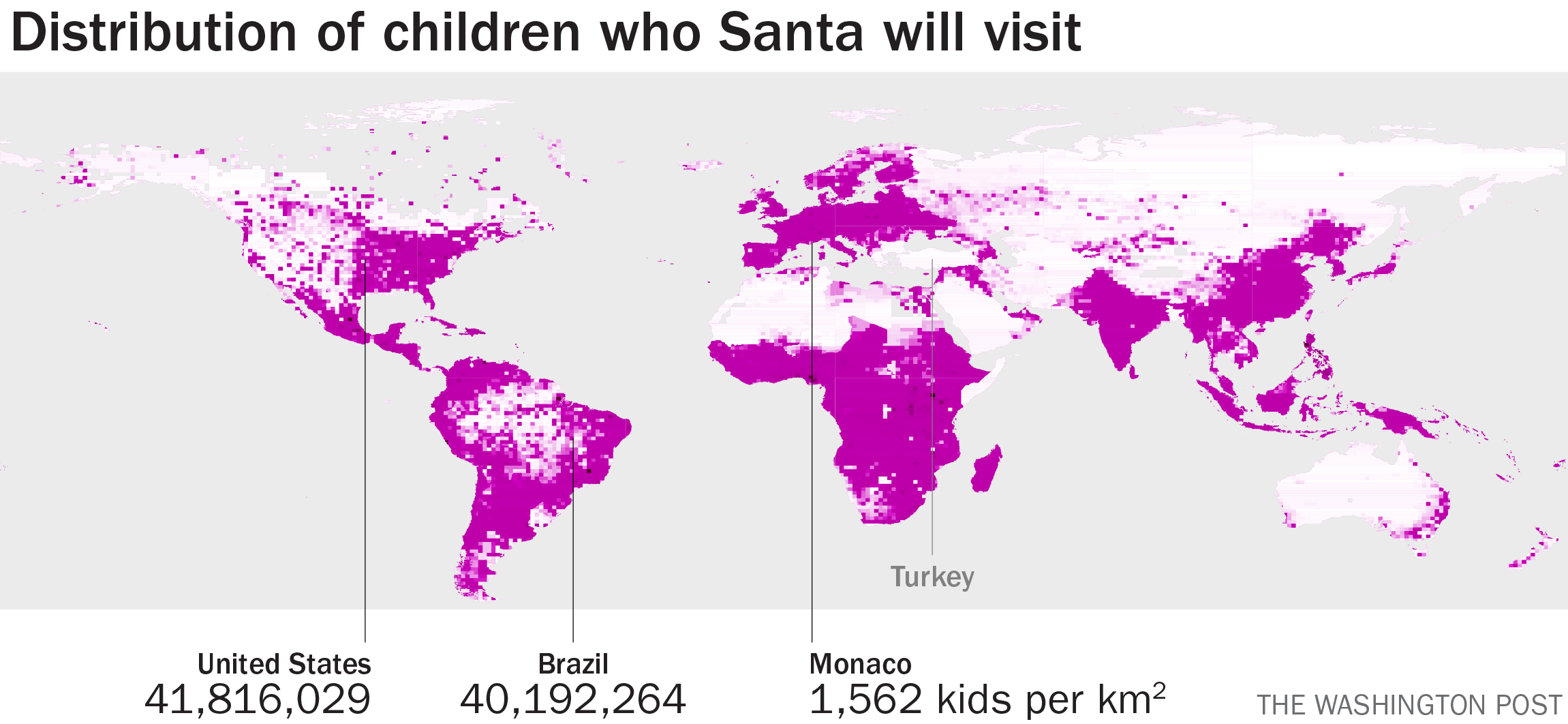 | At first, this just looks like a map of population density — until you notice details like that Turkey, largely Muslim, is empty. The countries with the most Christian kids are identified (the United States and Brazil) as is the country with the highest density of kids (Monaco). The color scale here doesn't convey the density of kids terribly well; China isn't heavily Christian but has a lot of kids so it looks like a denser target area than it actually is. In total, Santa needed to visit about 537 million kids in 2019, living in about 396 million households. Then we get to the mechanics of his doing so. Santa actually has more than 24 hours to get the job done, given that he can start at nightfall, traverse the world and then finish before sunrise. (It is useful for Santa that Christmas is in the Northern Hemisphere's winter.) Because of the movement of the sun, he travels from east to west, covering the United States near the end of the night. But children are not evenly distributed along his path, so he has to rush through the Western Pacific region and Australia to cover the Philippines, India and China so he has more time when he gets to Eastern Europe and Africa. Or, put visually: here's the density of kids by longitude and the range of north-to-south territory Santa needs to cover. Would be useful for him to being able to travel in a straight line, but he needs to hit Scandinavia and South Africa in the same nighttime hours. There are a functionally infinite number of ways in which he can hop from house to house, too many for any non-magical entity to calculate. But if we simply assume that each house is, on average, one mile from the next, he needs to cover 396 million miles in just over 35 hours. Or, he needs to travel at 11.2 million mph just to get from house to house, not counting the time it takes to hop down the chimney, drop off a present and eat a cookie. And yet he does it. And you thought your job was hard. | 





 Email
Email 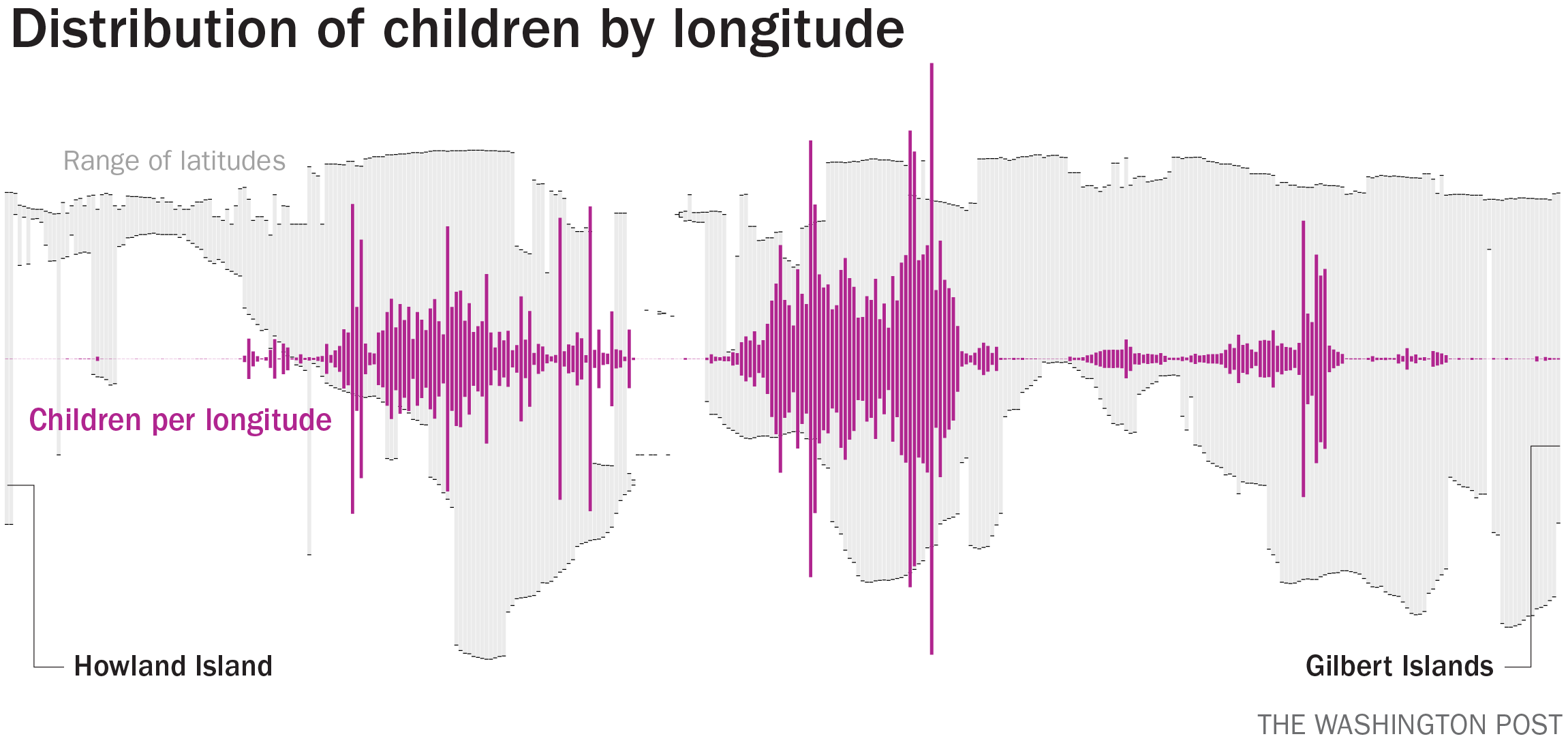



0 Comments:
Post a Comment